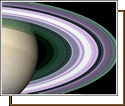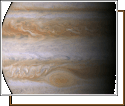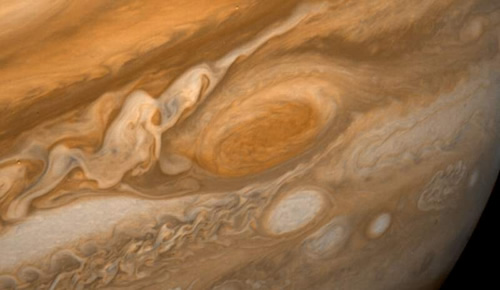
Unlike Earth, the giant planets are gaseous and don't have solid surfaces. Yet there are surprising similarities to our rocky planet, such as magnetic fields, weather, and seasonal changes. Sientists, like SSI's Heidi Hammel and Carolyn Porco, study the giant planets using Earth- and space-based telescopes and robotic spacecraft.
DID YOU KNOW?
- Could I Stand on One? No. The giant planets are
made completely of gas. But gas under pressures that increase enormously
as you move toward the core.
- Bling-bling. Saturn’s rings may be the flashiest,
but all of the giant planets have rings.
- Storms Bigger than Earth. The Great Red Spot on
Jupiter is a storm system that is so large several Earths could fit
inside it.
- Diamond Rain. Deep within Neptune,
the planet’s high pressures and temperatures may act on methane
to produce diamonds that rain toward the core.
- Two Way Traffic. Some of the giant planets have
moons that orbit backwards compared to the planet’s other moons.
Links to more information about the giant planets:
Cassini Mission to Saturn
Juno Mission to Jupiter
NASA's Planetary Photojournal
Galileo Mission to Jupiter
Solar System Exploration